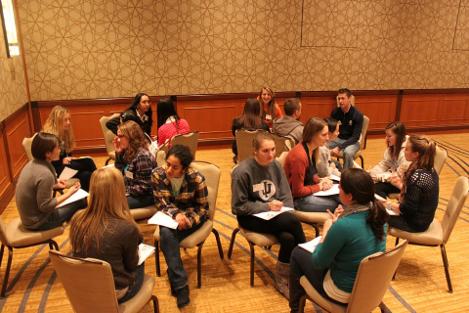
IgniteFebruary 11th, 2012
The first i-program I signed up for was Ignite. After researching the program, I anticipated to learn about organizational development. Specifically, how to facilitate organizational change in a large, small, grassroots, or non-profit organization through others, myself, or as a group. Other skills I hoped to develop were systems thinking perspective, building coalitions, working with stakeholders, and pitching ideas. All of these topics I have little knowledge or experience with.
One of the first things that Ignite taught me is that if you want to change something, you have to see that change in yourself. As Gandhi said, “be the change you wish to see in the world.” This quote carried through the entire day. When learning about change, I realized that everyone must be involved. Usually, those closest to a project are the most devoted, but people farther out need to be on board too. Sometimes, those people that are the furthest away from the change can have a game-changing idea, but if they do not know what is going on, they cannot share their breakthrough. Creating organizational change can be achieved when leaders of an organization follow these three steps: 1) utilize a systems-thinking approach, 2) identify stakeholders, and 3) utilize coalition-building.
The point emphasized is that everyone can have a hand in creating change, regardless how big or small the change initiative is or what that person brings to the table. The first step to successful change is taking a systems-thinking approach. In order to do this, one must recognize what and who will be affected by the change. By having such a broad outlook, major issues can be addressed before they become setbacks. The next steps are identifying stakeholders and utilizing coalitions. Stakeholders are those that are affected by or who affect the organization’s activities. These people may or may not be a part of the organization (Ignite participant manual, 2010, p. 28). Whereas a coalition is a group of individuals or organizations, acting for their own interest, who agree to join resources for a common cause (Ignite participate manual, 2010, p. 28). When striving for change, stakeholders are an important piece to consider because if the change negatively affects them, they could withdraw their support. If a coalition is formed to support your change initiative, this shows the amount of support your initiative has and the increasing number of resources that can be used to implement this change successfully. It is important to remember that all of this can happen on a small, community level as well as a large, international level. Regardless of size, the three-step process is the same.
The final takeaway of the day was pitching ideas. Successfully pitching your change idea is a fundamental step in getting people and organizations on board with the initiative. A successful pitch is simple, concrete, unexpected and story-centered. Keeping in mind these four basics will make any pitch I give memorable and set it apart from a long, dry, technical presentation.
Ignite focused on the skills of Organizational/Group Development; specifically, leading change and systems thinking. Applying what I have learned from leading change, I know I need to let my voice be heard. Any idea that I may have will never happen if I do not make it known. This I can apply to my final internship where we will be working as a group to put on successful golf tournaments. If I have an idea to make set-up more efficient, I need to voice the idea; otherwise, I will never know if it could have been successful. For systems thinking, I realized that I am already applying this skill in my role as President of the Sport, Tourism, and Recreation Association (STAR). While planning events I look to see who will be interested in coming, who I can advertise the event to, and who might want to participate in the planning of the actual event. All are elements of successful organizational leadership.
In addition to learning and applying leading change and systems thinking, I know I need to work on project and program effectiveness. Having an idea for change is one thing, but being able to put on an effective and efficient program or benefit for the change initiative is the next step that will set my idea in action.
Attending Ignite specifically helped with my goal of enhancing my community building skills. By looking outward and upward, I know I need to identify what a community wants and how they want it done in order to satisfy the stakeholders.